We Need Your Support
Donations are tax deductible and you will receive a charitable tax receipt for 100% of your gift.

Act Now

Empower U: Learn to Access Your Disability Rights Training on Canadian Human Rights, the Convention on the Rights of Persons with Disabilities (CRPD) and its Optional Protocol (OP) training aims to increase awareness of how to address discrimination using more familiar Canadian human rights laws such as Human Rights Codes and the newer international Convention on the Rights of Persons with Disabilities (CRPD). This is training for persons with disabilities by persons with disabilities. The training is part of a project funded by Employment and Social Development Canada and implemented by the Council of Canadians with Disabilities (CCD) in collaboration with Canadian Multicultural Disability Centre Inc. (CMDCI), Citizens With Disabilities – Ontario (CWDO), Manitoba League of Persons with Disabilities (MLPD) and National Educational Association of Disabled Students (NEADS). Read more.
Donate
CCD has worked for almost 35 years to build a more inclusive and accessible Canada. Our work has had significant results. Through the hard work of CCD volunteers and staff, in partnership with others, we have made transportation systems more accessible, elections more barrier free, students have better access to education and jobs, human rights have been expanded through court interventions, the Registered Disability Savings Plan and tax measures have put more dollars in people’s pockets, new data is being generated on who Canadians with disabilities are, and we have made clear the aspirations of Canadians with disabilities in foundational documents like the United Nations Convention on the Rights of Persons with Disabilities.
Much has been done but much remains to be done. Poverty, unemployment, and lack of supports remain. Sadly new barriers are being created. Going forward CCD will have less support from the Government of Canada and we must find other ways to support our mandate to improve the status of Canadians with disabilities. If you would like to help CCD in its ongoing work you can make a donation through Canada Helps or send a cheque to CCD at the address below. CCD is a charitable organization and will issue receipts for all donations.
The link below will take you to the Canada Helps link to CCD.
https://www.canadahelps.org/CharityProfilePage.aspx?CharityID=s3066
Together we can build a more accessible and inclusive Canada. Your support is appreciated.
What Canadians Say About CCD
"CCD has been an active and influential organization over the years. That includes having played a key role in the development of the United Nations' Convention on the Rights of Persons with Disabilities, which our government ratified last year. Ratification marks an important step in removing obstacles, creating opportunities and making Canada, as a whole, more inclusive." - Hon. Diane Finley, then Minister of HRSDC (2011)
"CCD continues to be a crucial association of Canadians with disabilities. Through tough times and through better times, over the past 30 years, CCD has been a resolute voice in advancing a vision of equality, human rights, dignity and full citizenship. We are closer to that vision today, though with so much more to do of course, due to the efforts of CCD." - Michael J. Prince, University of Victoria
"CCD has been a strong, clear and consistent voice for the dignity and equality of persons with disabilities over the past 30 years. It has played a key role by bringing disability issues before Parliament and the Supreme Court of Canada. I have been very proud to have been associated with CCD and to have played a small role in its work." - Harry Beatty, lawyer
"Over the years it has been my honour to serve CCD as its legal counsel on several occasions. From that vantage point, I have been present when CCD's disability-friendly model of equality was first adopted by other equality seeking groups, and then adopted by the Supreme Court of Canada in the Andrews case. I have seen CCD challenged aggressively and not back down. I have seen CCD threatened and subjected to financial duress, but carry on regardless. Without the vision, courage and determination CCD has demonstrated over the last 30 years Canadians with disabilities would have few if any of the rights they currently enjoy." - David Baker, lawyer
"CCD has been instrumental in convening meeting places where people with disabilities and other experts have been able to have important discussions, sharing insights, brainstorming and strategizing around how to secure the citizenship, human rights and well-being of people with disabilities. Throughout, CCD has ensured that the voices of people with disabilities have been heard and respected. Congratulations on your 30th anniversary, 30 years well spent indeed!" - Cam Crawford, Roeher Institute
"Through 3 decades of visionary leadership, solidarity building and human rights advocacy the Council of Canadians with Disabilities has been an inspiration to people with intellectual disabilities and their families; to all of us who advocate for a Canada of equality and inclusion. Thank you CCD." - Michael Bach, Canadian Association for Community Living
"We are so fortunate to have a strong, vibrant National Assembly like CCD in Canada where our headquarters is located. CCD is a great supporter of DPI's work internationally and has taken a lead role in Canada as we move towards a UN Convention on the Rights of Persons with Disabilities. Congratulations on 30 good years, CCD, and our best wishes for 30 more." - Venus Ilagan, Past Chairperson Disabled Peoples' International
We Need Your Support
A donation to CCD supports the voice of people with disabilities to speak out about:
- Poverty
- Employment
- Access
- Inclusion
- Citizenship
Together we can build a more accessible and inclusive Canada.
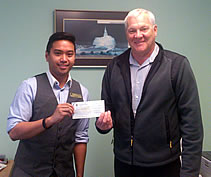
Royal Bank of Canada presents donation to CCD.